
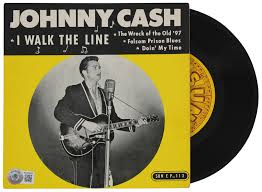

One of the songs I used to teach modulation—and as an entry point for students into Johnny Cash—is I Walk the Line. Cash gave a few different accounts of its origin over the years, but what seems to be the most widely accepted version is that in 1956 Marshall Grant (bass) started playing a riff backstage, Cash joined in with his guitar, added the opening lines, and then finished the rest of the tune on the ride to the next show. He described the lyrics as a pledge of devotion to his first wife, Vivian Liberto.
At first, Cash thought of it as a slow ballad, but Sam Phillips at Sun Records suggested speeding it up, and later that year it became Cash’s first #1 country hit, crossed into the pop charts (reaching #17), and went on to sell a couple million copies. It stayed on the charts for more than 40 weeks, which was a long run at the time. I’ve heard that if the band didn’t have a snare drum when they were on the road, Johnny slipped a piece of wax paper under his guitar strings to get a percussive effect (I’ve also worked with a bass player who did this).
I Walk the Line became one of his signature pieces. The 1956 recording was added to the Grammy Hall of Fame in 1998, included in the Rock & Roll Hall of Fame’s list of “500 Songs That Shaped Rock and Roll,” and ranked by Rolling Stone both among the 500 Greatest Songs of All Time (#30) and at the very top of its 100 Greatest Country Songs list in 2014.
Anyway, onto why I think it is a good tune for guitarists to learn.
The Core Progression
The song is built on one simple pattern:
V – I – V – I – IV – I – V – I
Here is a quick review on those three roman numerals:
- I (tonic): home base, where the music feels settled.
- V (dominant): creates pull back to home.
- V7 (dominant seventh): You can add the 7th to make the pull even stronger. I’m showing this option because it makes the resolution more obvious and helps you hear when a chord is functioning as tonic versus when it’s functioning as dominant. You can play it as a seventh or not—that’s up to you.
- IV (subdominant): adds variety without much tension.
One detail to notice: this progression doesn’t come in before the lyric. Cash begins each verse with a short vocal pickup, and the cycle starts after he sings the first couple words. For example, he sings “I keep a…” and then the word “close” is on the V chord. After the full progression runs its course, he holds on the I chord of the new key for four measures before the next verse begins.
Walking Through the Keys
The clever twist comes in how each verse shifts keys. Instead of adding new chords, Cash reinterprets what you’ve already heard, but in a new key:
Verse 1 (E major): B7 (V), E (I), A (IV).
B7 – E – B7 – E – A – E – B7 – E

Verse 2 (A major): E, which was I (tonic), now functions as V (dominant). A, which was IV (subdominant), now becomes I (tonic).
E7 – A – E7 – A – D – A – E7 – A

Verse 3 (D major): A, which was I (tonic), now functions as V (dominant). D becomes I (tonic).
A7 – D – A7 – D – G – D – A7 – D

Verse 4 (A major): D, which was I (tonic), now functions as IV (subdominant). A returns as I (tonic).
E7 – A – E7 – A – D – A – E7 – A
Verse 5 (E major): A, which was I (tonic), now functions as IV (subdominant). E returns as I (tonic).
B7 – E – B7 – E – A – E – B7 – E
This is a pivot modulation. A chord can serve as tonic in one verse and then immediately take on a new role in the next. Pivot modulation is a technique where a song smoothly changes from one key to another by using a pivot chord. This is also why I Walk the Line is such a good tune to learn: the constant key shifting gives you practice with different chord shapes while keeping the progression simple and familiar.
Why the Key Changes Work
- Strong cadences as anchors
Each verse ends with V → I, the strongest cadence in tonal music. That resolution makes the modulations sound natural and convincing. - The cycle of fifths in action
The tonal centers move E → A → D, following the circle of fifths. It’s a textbook demonstration of how harmony moves logically around the cycle. - Unchanging pattern
Even as the key shifts, the chord rhythm and order remain identical. The listener always hears continuity. - Three-chord economy
Every verse uses only I, IV, and V. It shows that modulation doesn’t require new chords—you can travel across keys with the most basic set. - Functional reinterpretation
The same chord takes on new roles. E is tonic in one verse, dominant in the next and then it’s gone. This is a clear example of how context defines function. - Pitch orientation through humming
Cash hummed the tonic before each verse to lock in the new key. It was his way of setting the root note before the modulation—something students can practice as well when working on key changes.
A Guitarist’s Angle
On guitar, the song highlights three common sets of open chords:
- In E: E, A, B7
- In A: A, D, E7
- In D: D, G, A7
Each move stays guitar-friendly, avoiding bar chords while teaching how chords take on new roles. Practicing the song is an easy way to hear functional harmony in action.
The steady alternating bass, “boom-chicka-boom” strum, and simple chord progressions show how arrangement and playing style can hold a song together. That is what lets the key changes flow so smoothly.
The Lesson for Students
“I Walk the Line” proves that a song can be both straightforward and sophisticated. For students and guitarists, the educational takeaways are clear:
- A chord’s role changes depending on the key.
- Key shifts can sound seamless when built on strong cadences.
- Even basic I–IV–V chords can create variety across verses.
- Simple performance tricks—like humming to set pitch—are valuable tools for real playing.
It’s a rare popular song that works as both a chart-topping hit and a classroom example of functional harmony.
Leave a Reply