
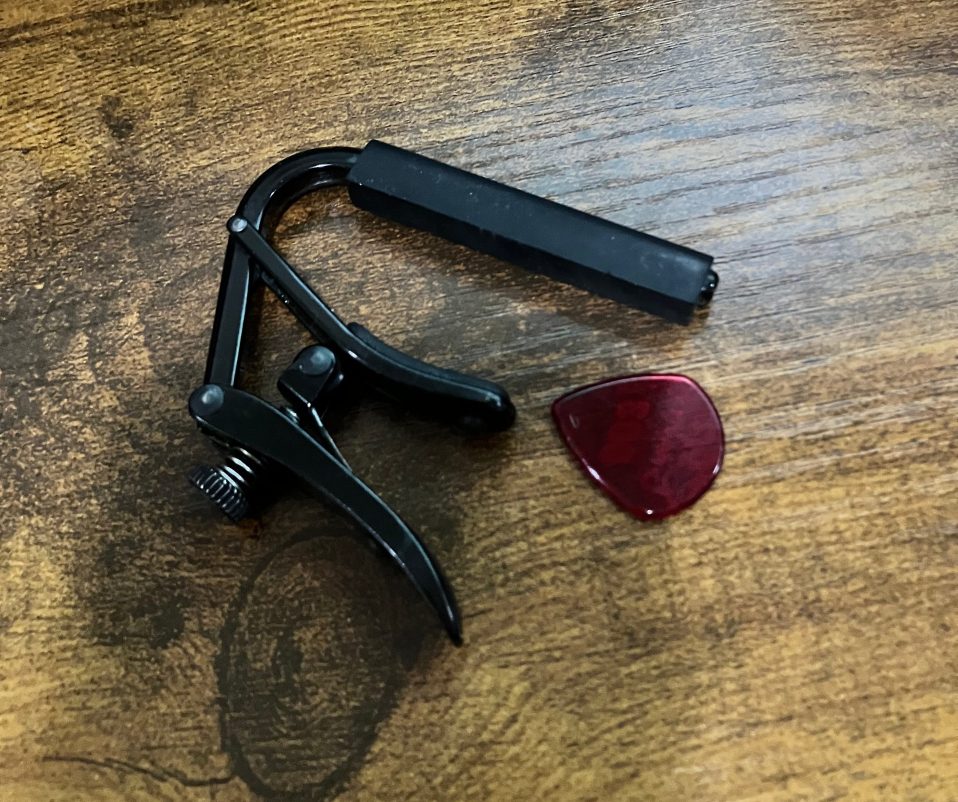
A capo is a small device that clamps across the guitar’s neck. It presses down all six strings at once, just like your index finger would in a bar chord (they do make partial capos, but that’s for another post). By doing this, it raises the pitch of the open strings. Another way to think of it: the capo is a new nut higher up the neck.
Why do you need one?
- Change keys instantly. Without a capo, if someone asks you to play a song in A♭ instead of G, you would need to know a new set of chord shapes, and they might all be bar chords. With a capo, you just move it to the right fret and use the same shapes.
- Sing more comfortably. If a song feels too low or too high for your voice, the capo lets you shift the song into a range that feels good without changing the chords you already know.
- Keep the open chord sound. Open chords ring out in a way bar chords don’t. With a capo, you can keep that warm, full sound even when you’re playing in unusual keys. This may be the most important, some chords sound more stereotypically “like a guitar”
Capos show up in many styles of music:
In country and rock, the capo helps players keep open chords where they would otherwise require bar chords.
In folk and pop, they make it easier to play and sing in the right key.
In bluegrass, players rely on them to stick with G or C shapes while following fiddles and banjos into other keys.
In flamenco, the capo is called a cejilla. It’s used not just to match a singer’s range but to preserve traditional tonal centers that depend on open strings. For example, por arriba and por medio each rely on open-string shapes. The cejilla lets guitarists slide these positions up the neck, keeping the resonance and characteristic voicings intact. Certain falsetas and progressions are built around those shapes
What changes when you add a capo
Think of the guitar without a capo as “home base.” Your open strings are tuned to E–A–D–G–B–E, and every chord you play is built from there. When you add a capo, that “home base” shifts. Wherever the capo sits becomes your new set of open strings.
Here’s what that means in practice:
- Without a capo: the open 6th string is E.
- With capo on the 3rd fret: the “open” 6th string is now G.
- Every other string also shifts up three half steps.
So if you strum a G shape with the capo on the 2nd fret, you’re not really playing G anymore—you’re playing A. The guitar has been transposed up two half steps, but your fingers don’t have to learn anything new.
Why this matters
- You don’t have to memorize dozens of bar chords right away.
- You can instantly change the key of a song to fit your voice or another instrument, but still use familiar, open chords.
Try this quick exercise:
- Strum an open C chord. Listen to its sound.
- Put a capo on the 5th fret and play the same C chord shape.
- Now you have a higher sounding chord. It’s actually an F chord, but it still feels like C under your fingers. At this point the guitar is in ukulele territory, since a standard uke is tuned like the top four strings of a guitar with a capo on the 5th fret.
That’s the magic of the capo: it re-labels the fretboard without asking you to relearn your shapes.
Using CAGED shapes with a capo
Most beginners start with the open chords C, A, G, E, and D. Together, these five form the CAGED system. The name is easy to remember, and the idea is simple: those shapes can be shifted and reused all over the neck.
When you place a capo, you’re not learning new shapes—you’re reusing the same five. The capo just moves them into a new key. That’s why the CAGED system and the capo go hand in hand.
Here’s the key point:
- The shapes stay the same under your fingers.
- The sound changes because the capo redefines what “open” means.
For example:
- If you play a G shape with no capo, you’re in G.
- If you move the capo to the 2nd fret and still play the G shape, you’re actually playing an A chord.
- At the 5th fret, the same G shape becomes a C chord.
This is what makes the capo so powerful. You only need to know a handful of shapes, and suddenly you can play in almost any key.
Quick connection to real songs
- “Wonderwall” mostly uses shapes built from E and G families, but with capo 2 it lands in F♯ minor.
- “Teardrops on My Guitar” uses G family shapes with capo 3, giving it that ringing sound in B♭.
Both are simple progressions you can play right away if you know your CAGED chords.
Example: Transposing with the Capo
Say you’re learning a song in the key of E major. The main chords are:
- E | A | B | C♯m
That means two of the four chords (B and C♯m) are barre chords. For a beginner, that can make the key of E a tough place to play. A capo gives you easier options.
Option 1: Capo 2, play D shapes
- Shapes: D | G | A | Bm
- Sounds as: E | A | B | C♯m
Now you’re still in E major, but the only bar chord left is Bm. Much easier than having two bar chords.
Option 2: Capo 4, play C shapes
- Shapes: C | F | G | Am
- Sounds as: E | A | B | C♯m
Same key, but now the only barre chord is F. If you’re more comfortable with shapes in the key of C, this can feel easier.
Option 3: Capo 7, play A shapes
- Shapes: A | D | E | F♯m
- Sounds as: E | A | B | C♯m
Here you only have one bar chord again (F♯m). It’s a good choice if you like shapes associated with A major.
Option 4: Capo 9, play G shapes
- Shapes: G | C | D | Em
- Sounds as: E | A | B | C♯m
At the 9th fret, you can use G shapes to play E, A, B, and C♯m with no barre chords. The chords sit higher on the neck, and the frets are closer together, which can make them easier to hold.
When you’re playing with others, these different capo spots make a big difference. One guitarist might stay low in open E, another might use capo 2 or 4, and a third might sit at 7 or 9. Everyone is in the same key, but the chord voicings spread across different registers, which keeps the parts from clashing and helps the group sound balanced.
Tips for beginners
Place the capo just behind the fret, not on top of it. This gives you a clear tone without buzzing. If the guitar sounds sharp, adjust the capo’s pressure or retune.
Practice by taking one song and trying it in several capo positions. Notice how the shapes stay the same but the register changes. Listen for how the chords sit lower or higher depending on where you put the capo.
If you play with another guitarist, experiment with using different capo spots on the same song. The chords will match, but the voicings will spread out across the neck. This makes two guitars sound fuller than both playing the same shapes in the same position.
Wrap-up
A capo is a simple tool, but it opens the guitar up in powerful ways. It makes hard keys easier, keeps open chords available, and changes how the guitar fits with singers and other players. Learning how to transpose and use the capo will will allow you to play almost any song in any key.
Leave a Reply